
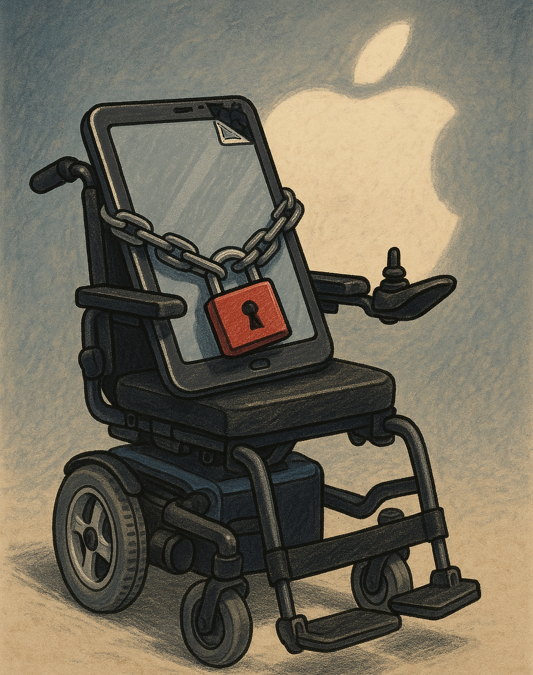
WWDC is coming up on June 9, and Apple is once again talking about convergence — how iPadOS, macOS, and iOS are going to become even more aligned. That sounds exciting on the surface. But for those of us who rely on these tools not just for convenience but for accessibility and independence, it’s time to ask a harder question: Why isn’t Apple finishing what it starts — especially when it comes to accessibility?
Apple loves to talk about accessibility. They highlight it in keynotes. They win awards for it. They’ve become the gold standard in many ways for integrating accessibility features into the core of their products — not bolting them on as an afterthought. And I respect that. But here’s the thing: if you’re going to make accessibility part of your brand identity, you have to follow through.
I get it. The disabled community is incredibly diverse. One-size-fits-all doesn’t work. There are so many nuances — physical, cognitive, sensory — and no tech company can build for every single edge case. I’m not asking for that. But the things I’m talking about here? These are not edge cases. They’re not bleeding-edge hardware requests. They’re not a massive reinvention of the ecosystem. Everything I’m describing is technically possible right now. All the pieces are already there. From a technology standpoint, Apple is just choosing not to finish the job.
Let’s start with cellular. We’ve had SIM-enabled tablets and LTE-capable devices for over a decade. But if I want to buy a MacBook with built-in cellular? Nope. Doesn’t exist. Still.
Meanwhile, I have a dear friend who is nearly nonverbal. She can speak, but it’s hard to understand her unless you’re really focused. She relies entirely on texting and email to communicate. She uses an iPad with a cellular chip — a fully connected device. But unless she’s messaging another Apple user, she can’t send a text message. Why? Because SMS still requires an iPhone. Let that sink in: she has a cellular device, and she still has to buy and own another device she can’t really use, just to send a text to someone on Android.
Apple doesn’t want to cannibalize iPhone sales. I get that. But you’ve already done it. You put a SIM in the Watch. You let people leave their phone at home and still take calls. So what are we protecting at this point? Revenue, or dignity?
I’ll never forget the day dictation first came to the iPad. I had traded in my previous model just to get the one that supported it — I think it was the iPad 3. And when I sat there in the Apple Store, tapped that little microphone icon, and started speaking to my device for the first time… I actually cried. It was the first time I felt like the device understood me on my terms, not the other way around. It changed the way I work, communicate, and navigate the world. It was that powerful.
So when I say Apple has led the charge in accessibility, I mean it. I lived it. But that’s also why I’m so frustrated now — because I know what this company is capable of. I’ve seen it. And lately, it feels like they’ve stalled.
When I bought my M1 iPad, I thought it might become my primary computer. The vision was simple: plug it into a display at my desk, use a keyboard and mouse, get real work done. Then unplug it, toss it in my bag, and take it wherever I needed to go.
And to Apple’s credit, they’ve come a long way. External display support. External keyboard and mouse. Cellular chip. File access and multitasking. But then the friction starts. I use dictation constantly — not because it’s fun, but because it’s essential. Apple’s built-in dictation is flawless. Microsoft’s is slow, clunky, and cloud-dependent. But if you have a keyboard and mouse connected to the iPad? Good luck getting the onscreen keyboard to appear so you can hit the microphone button.
Then there’s my radio show production workflow. I drag tracks between a player and a digital audio workstation. On iPadOS? That gesture is clunky and inconsistent with touch. And building webpages? The tap targets are too imprecise — editing becomes a struggle, not a tool.
Everything I need to do is almost there. But “almost” doesn’t work when you need a device to be reliable. “Almost” breaks the moment you step outside of Apple’s ideal use case.
I’ve considered the Microsoft Surface. Full OS. Tablet mode. Real ports. A proper file system. From a feature standpoint, it offers the best of both worlds — except where it really counts for me: speech tools and accessibility. Microsoft still hasn’t caught up. Their dictation has to “phone home” to process speech and send results back. That lag? It kills the workflow. It makes interaction feel like a chore instead of an extension of your thoughts.
So yeah, I’m deep in the Apple ecosystem. Not because it’s trendy. But because, for disabled users, Apple still does some things better than anyone else.
If Apple is going to stand on the stage at WWDC and talk about accessibility again — then I want them to actually deliver. Let people send SMS from an iPad without needing an iPhone. Put cellular chips in every MacBook. Let iPads be true laptop replacements, not just the illusion of one. Don’t punish users for relying on dictation, or for needing to plug in a mouse and still talk to their device.
These aren’t “nice-to-haves.” These are the things that make the difference between independence and frustration for real people every day.
You’re so close, Apple.
The hardware is there. The software is almost there. The accessibility branding is everywhere.
Now finish the job — and make the tools as seamless and empowering as you claim they are.
Because “it just works” isn’t good enough… until it works for everyone.
Have something to say? We welcome your comments below — this is where the real conversation happens.
Each blog post is shared across our social transmitters, but those are just bigger antennas. The original source — and the signal we control — is right here on the blog. If you’re looking for other ways to stay updated on Rolling with Scissors, you’ll find our official transmitters linked below.
Spin the dial — we’re probably on it. Lock onto your frequency. Pick your favorite antenna below and ride the signal back to us.