
The first rule of traveling through dead country was simple: move at night, stay invisible.
Cronauer kept to the abandoned railbeds west of Madison, boots crunching softly over gravel that hadn’t seen a freight train since the collapse. Trees choked the edges of the old right-of-way, giving him cover from whatever might be watching. Once, these tracks had hauled grain and iron and dreams across the Midwest. Now they were just scars on a broken landscape.
The nights were cold. The stars were sharp enough to cut. And the farther he got from the skeletal glow of Madison, the quieter the world became—not peaceful quiet, but hunted quiet.
He traveled light. A battered backpack with the essentials Norm had packed. A Glock 19 holstered under his jacket. A paper map, already smudged with sweat. And tucked deep inside: the ham radio Norm had pressed into his hands, still operational, still lifeline.
Norm had given him new rules before he left:
No real names over the air.
Use call signs only.
Trust no one blindly.
Cronauer’s radio name would simply be Cronauer. Norm would answer to Ghost of Tom Joad—fitting for a man holding the last fragile threads of a broken community together. If anyone else earned a place on the waves, they’d need a name too.
Three nights in, somewhere west of Cross Plains, exhaustion finally caught up.
He stumbled into a hollow barn on the edge of an abandoned farmhouse—half-expecting to find the place already picked clean or worse, occupied by desperate men. Instead, the barn was silent, save for the smell of old hay and diesel oil.
He curled up in a corner, rifle laid across his chest, and let himself drift into uneasy sleep.
At dawn, a voice snapped him awake.
“You sleep heavy,” said a man silhouetted against the rising sun.
Cronauer’s hand flew to his Glock, but the man only raised a calming palm. He was dressed plainly—worn jeans, suspenders, a battered wide-brimmed hat. No malice. No fear.
“I don’t want trouble,” Cronauer rasped.
The man shrugged. “Neither do I.”
He introduced himself simply as Eli. No last name. No town. Just a man making do after the world had gone sideways.
Over a breakfast of cold bread and water, Eli explained that he’d been part of a nearby Amish community near Soldiers Grove. After the collapse, when the supply chains snapped and fear rotted the cities, he stayed behind—tending the land, salvaging what he could, adapting in the quiet way survivors did.
Cronauer told him—carefully—that he was headed west. Toward a small station in Viroqua. Toward a transmitter that still might be breathing.
Eli studied him for a long moment, then stood and disappeared into a nearby shed.
When he returned, he led out a battered old horse harnessed to a creaking buggy.
“It ain’t pretty,” Eli said, patting the animal’s flank. “But it’ll get you there.”
For the first time in days, Cronauer let a little hope creep in.
He wouldn’t have to walk the entire way after all. Maybe, just maybe, he could ride the last desperate stretch into Viroqua.
Before Cronauer left, Eli showed him something else—tucked into the back of his farmhouse was a working ham radio rig, cobbled together from salvaged parts.
Eli grunted when Cronauer’s eyes widened.
“Faith keeps a man strong,” Eli said. “But faith don’t carry a signal across the hills.”
They quickly agreed to basic protocols:
No real names.
Limited chatter.
Eli would answer to Simple Farmer on the air.
Cronauer would stay Cronauer.
It wasn’t much. But it was another voice in the dark—another thread of humanity trying to stitch the world back together.
The buggy rattled along the cracked blacktop, the old horse plodding steadily westward. Cronauer had no choice now but to stick to the main roads. The railbeds and footpaths that once shielded him were useless for a wagon and animal. Out in the open, exposed, he pushed onward—hoping speed would beat danger.
He approached Readstown near sunset—a place he remembered dimly from old drives through the Driftless hills. Nothing but a wide spot in the road, a gas station, a fireworks depot, and a few sagging houses clinging to a forgotten corner of the state.
The Cheapo Depot and Fireworks Outlet stood half-collapsed ahead, its front sign hanging crookedly in the dying light.
That’s when the shouting started.
Men in mismatched camouflage and battered red hats staggered out from the ruins of the fireworks outlet, rifles slung carelessly but fingers itching.
The kind who thought a stockpile and a slogan were enough to outlive the end of the world. The kind who never learned that survival meant work, not war.
Cronauer tried to steer the horse and buggy away, but they closed in too fast.
One rushed him—half-drunk, half-crazed.
Cronauer reacted on instinct—pivoted, and drove the butt of his .308 into the man’s jaw, dropping him cold.
But there were too many.
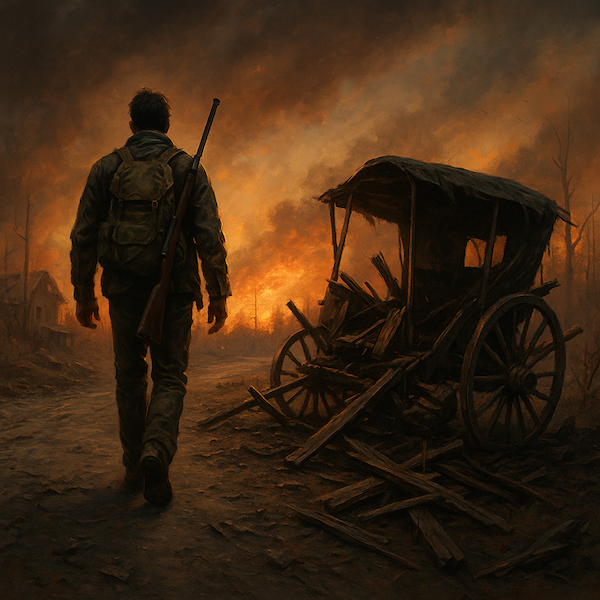
The others yanked the horse’s reins, laughing as they tore it free. The buggy crashed sideways into the ditch, wheels splintering.
Cronauer clutched his pack, his pistol, his rifle—and ran. No shots fired. No blood spilled. Just another inch of survival lost to the lawless dark.
Cronauer watched them ride off, whooping and careless, leaving chaos in their wake.
He had seen their type before—loud, angry men who thought survival was about stockpiling guns and shouting slogans. When the world cracked, they expected to roll over everyone else by force alone.
But real survival wasn’t about noise.
It was about patience.
Precision.
Knowing when to fight and when to fade away.
He wasn’t a prepper.
He wasn’t a soldier anymore.
He was something else—something quieter, sharper.
Raised by parents who taught him the real meaning of the Second Amendment: not to threaten, but to defend. Trained by circumstance to end a threat if he had no other choice—but never to draw first blood without cause.
And today, restraint had saved his life more surely than a bullet would have.
He adjusted the battered pack on his back, slung the rifle tight across his shoulders, and set off again.
West.
Always west.
Toward Viroqua.
Toward the ghost of a transmitter still waiting to be found.
Enjoying the story? Signal Drift is unfolding one chapter at a time right here on the blog. Got thoughts, theories, or feedback? Drop a comment below — that’s where the real conversation happens.
Every chapter also beams out through our social transmitters, but if you’ve made it this far, you’re already tuned into the right signal.
Want to dive deeper into the world? Meet the characters of Signal Drift — and keep an eye on that page, because it’ll evolve as the story does.
Spin the dial — we’re probably on it. Lock onto your frequency. Pick your favorite antenna below and ride the signal back to us.
Facebook | Instagram | Threads | Bluesky | X (Twitter)