
So, I’m in a few disability groups on the social transmitters (yes, we let uppies — upright people — join too). And someone recently asked, “What’s the hardest part about being disabled?”
I laughed out loud. My immediate answer was: You want the list?
Of course, the answer is different for everyone. Disability is a spectrum, and people’s experiences vary wildly depending on the type of disability, the amount of support they have, and especially — where they live.
Here’s something most people don’t think about: the colder the state, the better the services. Wisconsin, Colorado, even Maine — if the weather sucks, there’s a better chance someone will help you out when you’re gimpy. It’s like a consolation prize for the snow and ice. It’s not a rule, but it’s a pattern.
There are a few “carrot” states like California that offer better support, but as you’ve probably read in my past posts, Florida — where I currently reside — is not one of them. Services here are minimal. Housing is a nightmare. Transportation? Nearly nonexistent. And trying to move? Oh, you sweet summer child.
For non-disabled folks, moving is as simple as packing up a truck, finding an apartment, and settling in. But when you use a wheelchair and rely on disability services? It’s a bureaucratic obstacle course laced with landmines.
I know what some of you are thinking: Just get a job and move. Sounds great on paper. But here’s the reality: I’ve got a solid resume. I’ve passed plenty of first screenings. Then I show up to the interview and the recruiter sees the wheelchair. I can see it in their eyes — the shift, the uncertainty. They’re doing the math in their head. Accommodations. Costs. Liability. Then the interview ends… and I get ghosted.
Yes, that’s illegal. But unless you have unlimited time and money to fight it? Good luck.
And if I do land the job? The insurance might not cover the equipment I rely on. A power wheelchair starts at around $38,000. A decent manual chair runs six grand. Pre-existing condition — that ugly little loophole that never quite dies — often means the cost falls to me.
Now let’s talk housing. A non-disabled person can crash in a cheap apartment, no big deal. I, and many others like me, need basic accessibility — like a roll-in shower. Not a luxury. A necessity. If you’ve got deep pockets, sure, you can renovate anything. But if you’re on Social Security (because employers keep ghosting you), you’re stuck navigating the low-income accessible housing world — and that is a beast of its own.
Here in my county in Florida, the waitlist for accessible housing is nearly four years. And there’s no reliable transit. I can’t drive. Many of us can’t — whether due to physical limitations or the $60,000+ price tag of modifying a vehicle.
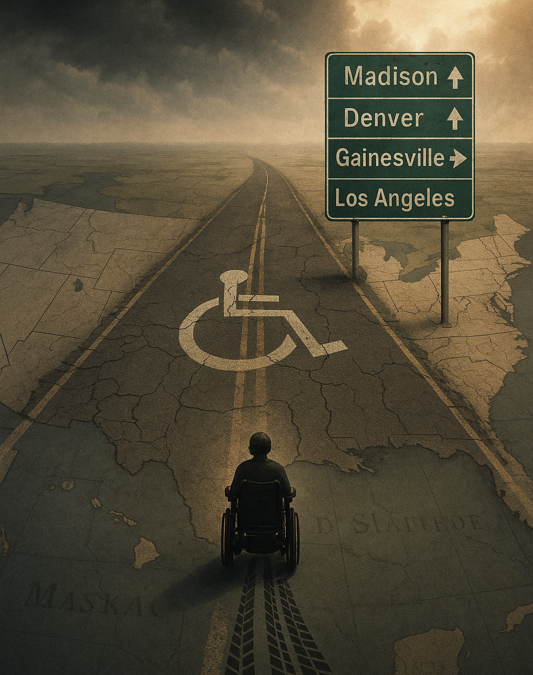
If I stay in Florida, Orlando has more services, but longer waits. Gainesville is like Madison without the snow — great accessibility, strong transit — but housing waits are five years long. Madison, my hometown? If I were still living in Dane County, the housing wait would be manageable. But because I moved out of state for medical reasons, I’m looking at a three-to-four-year waitlist.
Now sure, I’ve got dear friends in Madison who would let me crash on their couch for as long as I needed to — and I’m beyond grateful for that. But let’s be honest: even the best of friendships can strain when you’re essentially living in someone else’s space. No matter how close you are, it creates a weird dynamic. You’re not home — you’re a guest. And that wears on everyone after a while.
Then there’s Denver. From what I’ve heard, they’ve got decent services, accessible Ubers (which don’t exist most places), and shorter housing waitlists. It’s tempting. Especially since my medication isn’t questioned there. But I don’t know Denver well. I’ve got no safety net.
California? Friends keep telling me I’d thrive there. But figuring out how to get in — let alone access the services — feels like solving a Rubik’s cube with my feet. And let’s be real: the ground moves whenever it wants. I like my wheels firmly on stable earth, thanks.
I’m not telling you all this for sympathy. I just want you to understand that for many disabled people, relocating isn’t a simple “just go” move. It’s not laziness. It’s not fear. It’s math, red tape, and broken systems.
If it were as easy as picking a spot and going, I’d be back in Madison already. Or in Denver. Or wherever the hell life could be easier to live.
But that’s not how it works — not when you roll instead of walk.
Have something to say? We welcome your comments below — this is where the real conversation happens.
Each blog post is shared across our social transmitters, but those are just bigger antennas. The original source — and the signal we control — is right here on the blog. If you’re looking for other ways to stay updated on Rolling with Scissors, you’ll find our official transmitters linked below.
Spin the dial — we’re probably on it. Lock onto your frequency. Pick your favorite antenna below and ride the signal back to us.