
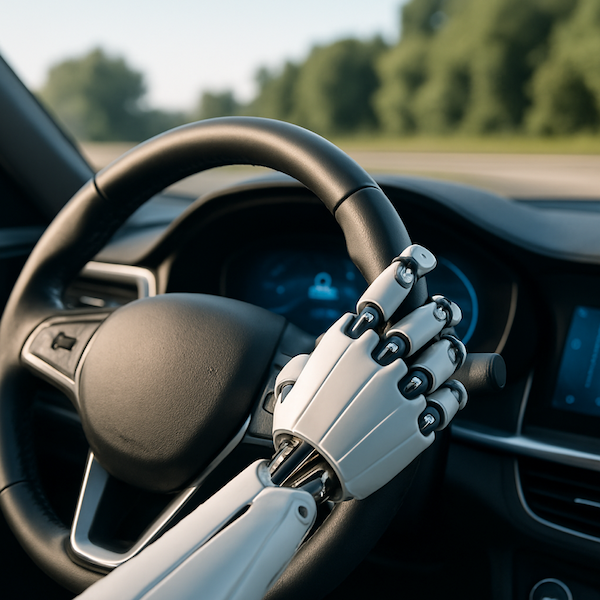
don’t drive. Not because I don’t want to. Not because I’m afraid. Not because I’m incapable. I don’t drive because I use a wheelchair and have cerebral palsy — and adapting a vehicle with hand controls and a ramp starts at around $60,000, on top of the cost of the car.
That number isn’t an exaggeration. It’s reality. Even with grants and assistance programs, that kind of money is out of reach for most disabled folks. So I don’t drive — and before you say “just use a manual wheelchair,” let me stop you right there.
Pushing a manual wheelchair is not a solution. Would you walk across an entire city with just your arms? That’s what a manual chair asks of your body. Your arms weren’t built to do what legs do all day. It’s exhausting, painful, and slow. That’s why I rely on a power chair — and that makes getting into a standard vehicle even more of a trick. It’s not just about transportation — it’s about accessibility, independence, and basic dignity.
Which brings me to this: we’re on the edge of something big, and if we do it right, it could change everything for people like me.
I’m talking about autonomous vehicles.
Elon Musk and Tesla keep teasing their self-driving tech — and while some of it is vaporware and half-baked PR, the core idea is very real. The technology exists today to make a car drive itself. Yes, it’s buggy. Yes, it still screws up. But show me one major invention that didn’t kill some people on the way to being commonplace. (Hi, airplanes.)
And let’s stop right there for a second — because most people have no idea how much automation is already running the world around them.
Let me break this down: if you’ve been on a commercial airplane in the last 10 years, you’ve already trusted a computer with your life.
Modern planes use what’s called an autopilot system — and it’s not a backup, it’s the main operator. On most major commercial flights, the pilot programs the destination while still at the gate, taxis the plane to the runway, and then pushes a button. From there, the computer handles the takeoff. Once the plane’s in the air, it flies itself. As you approach your destination, the system begins descent, lines up with the runway, and depending on the conditions, can even land the plane on its own — sometimes without the pilot touching a thing.
The pilot? Their job is to monitor the system and intervene only if something goes wrong. We trust this every single day, on every major airline, in every corner of the world. And yet somehow, the idea of a car doing the same thing freaks people out.
Meanwhile, those of us who can’t drive are stuck playing roulette with unreliable transit options — if they even exist where we live.
Yes, there are cities with wheelchair-accessible taxis. I’ve used them. It’s still a human driver, but they’re specially equipped vans that allow you to roll in, lock down, and go. That’s awesome — when you can find one.
But guess what? They’re not everywhere. Not even close. Especially not in the South.
Where I live now, the concept of an accessible taxi is laughable. You’re lucky to get a city bus that kneels properly, let alone a ride service that can handle a power chair. So you’re either stuck, calling a friend, or shelling out huge money for a private van — assuming you can even find one available.
So when I hear people — even other disabled folks who can drive — say, “I’d never trust a computer to drive me,” I just shake my head.
You already do. You do it at 35,000 feet.
It’s not that I don’t trust myself. It’s that I don’t trust the jackass swerving into my lane while scrolling TikTok at 60 miles per hour. Let’s take the human error out of the equation. Let’s give independence back to the people who’ve been boxed out of the car culture for decades. Let’s stop pretending we don’t already have the blueprint.
Because autonomy, for me, doesn’t mean being in control of a steering wheel. It means being able to go — without begging for a ride, without rolling into another dead-end system, and without waiting for someone else to get around to including me.
We’re closer than you think. The only question is whether society gives a damn enough to finish the job.