
This morning, like I do some mornings, I asked Alexa to play a song.
“Alexa, play Roxanne by The Police.”
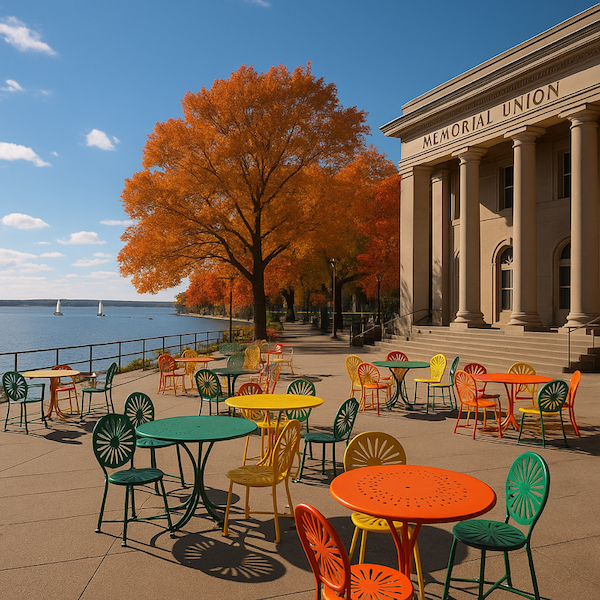
A few seconds later, those first few iconic notes hit—and just like that, I wasn’t in my bedroom anymore. I wasn’t waking up slowly or shaking off the sleep. I was back in Madison, Wisconsin, sometime between the late ’80s and early ’90s. I was probably 10, maybe 12 or 13. And I can still see it—clear as day—the inside of the Memorial Union, the smell of popcorn and floor wax, and in the corner, a glowing, humming jukebox.
Now, let me pause for a second, because there’s a good chance some of you reading this have never seen an actual jukebox. These were big, glowing machines full of music—rows of records or CDs you could flip through, pick a song using a letter and number combo, and drop a coin in to hear it play. There was a real magic to it. You could hear the mechanical click as it found your song, the whirr of the selector arm, and then—music. It wasn’t just a listening experience; it was a ritual.
That jukebox had Roxanne in it.
I didn’t pick it—someone else did. But it was the first time I ever heard that song, and it stopped me in my tracks. I had no idea who The Police were or what the lyrics meant, but I knew something about it mattered. Sting’s voice was raw and urgent. The melody pulled you in. It was one of those moments where the world tilts just a little, and you suddenly realize music isn’t just sound—it’s memory waiting to be made.
I wasn’t standing in front of that jukebox—I was sitting in my wheelchair, just off to the side, taking it all in. The Memorial Union had always been a special place for me. My dad went to school in Madison and introduced me to the Union when I was really young. So when I got old enough to cruise around on my own, where did I end up? The Union. Over and over. It felt like home. Still does.
Funny thing is, I looked it up after Alexa played it—just to double-check—and yep, Roxanne was released in the UK on April 7, 1978. Just a few days ago, in fact. So here I am, nearly 50 years later, asking a voice assistant to play the same song I first heard in that old building, nearly a decade after it came out. If that’s not a time machine, I don’t know what is.
I’ve said before that music has a way of pulling you right back to a time and place. This morning proved it again. One simple command, and suddenly I’m in my chair by that jukebox—just a kid soaking in the energy of the room and hearing Roxanne for the first time. I didn’t understand all of it, but I felt it. And I still do.
And yeah, maybe I sound like an old man shaking his fist at the cloud right now, but let’s be real: all the best music came out of the ’70s and ’80s. That era didn’t just give us songs—it gave us moments. Music that took risks. Music that wasn’t afraid to be controversial or weird or raw. You think a song like Roxanne would get written today? I doubt it. Too controversial. Not woke enough. Somebody would start a hashtag, and it’d get shut down before the first verse.
But back then? It was just a damn good song. One that told a story. One that stuck with you. One that didn’t need a disclaimer before it played.
Maybe that’s why it still hits hard today. Because it reminds me of when music didn’t have to ask permission. When one random song on a jukebox could change your whole outlook—or at least make you pause and feel something real.
So yeah, Alexa’s convenient. She can cue up anything. But she can’t make you remember. That’s still on us. That’s still on the songs that matter.
And this morning, Roxanne reminded me—loud and clear—why they still do
You are so spot on. Music is timeless and also time/event specific. Like a Time Machine you suddenly find yourself back in a moment of your life that was/is significant and usually personal. ❤️ Thanks for the reminder.